


Long before I began writing about leadership, I witnessed a moment at work that has stayed with me for years.
There was a senior executive, someone smart, charismatic, and well respected who became captivated by a new product idea. In their mind, it wasn’t just a concept; it was the breakthrough, the thing that would tilt the market and redefine the company’s trajectory.
Our team did what teams do: we ran the research, built the prototype, and pushed the idea through every lens we had and measured its viability, desirability, and feasibility. And at every turn, the results were the same. The numbers didn’t hold. The risk outweighed the return. The market simply didn’t want what we were building.
But the truth wasn’t the hard part.
The hard part was deciding whether to say it.
Inside the team, the debate grew quiet and tense. Some suggested we keep going and “let the data speak for itself over time.” Others worried, with good reason, that this leader wasn’t going to welcome the bad news. A few of us wondered out loud about the cost of silence: the money being spent, the hours being pulled from higher-value work, the opportunity cost that no spreadsheet could capture.
Looking back now, I’m certain of something I wasn’t sure of then:
The executive would have wanted to know the truth.
Not because it was comfortable, but because clarity is the only real currency leaders have.
No one told them.
Not because they lacked integrity, but because they lacked psychological safety.
That experience became the first of many moments where I saw how silence shapes organizations. Over the years, I’ve collected dozens of stories like this, sometimes as an employee caught in the middle, other times as a leader realizing just how much I wasn’t hearing.
Those moments inspired me to write this article.
Because the truth is:
What your team won’t tell you can hurt your business far more than what they do tell you.
Silence is expensive. In organizations of any size, employees routinely withhold information their leaders desperately need: misaligned priorities, internal friction, or the inefficiencies that drain performance.
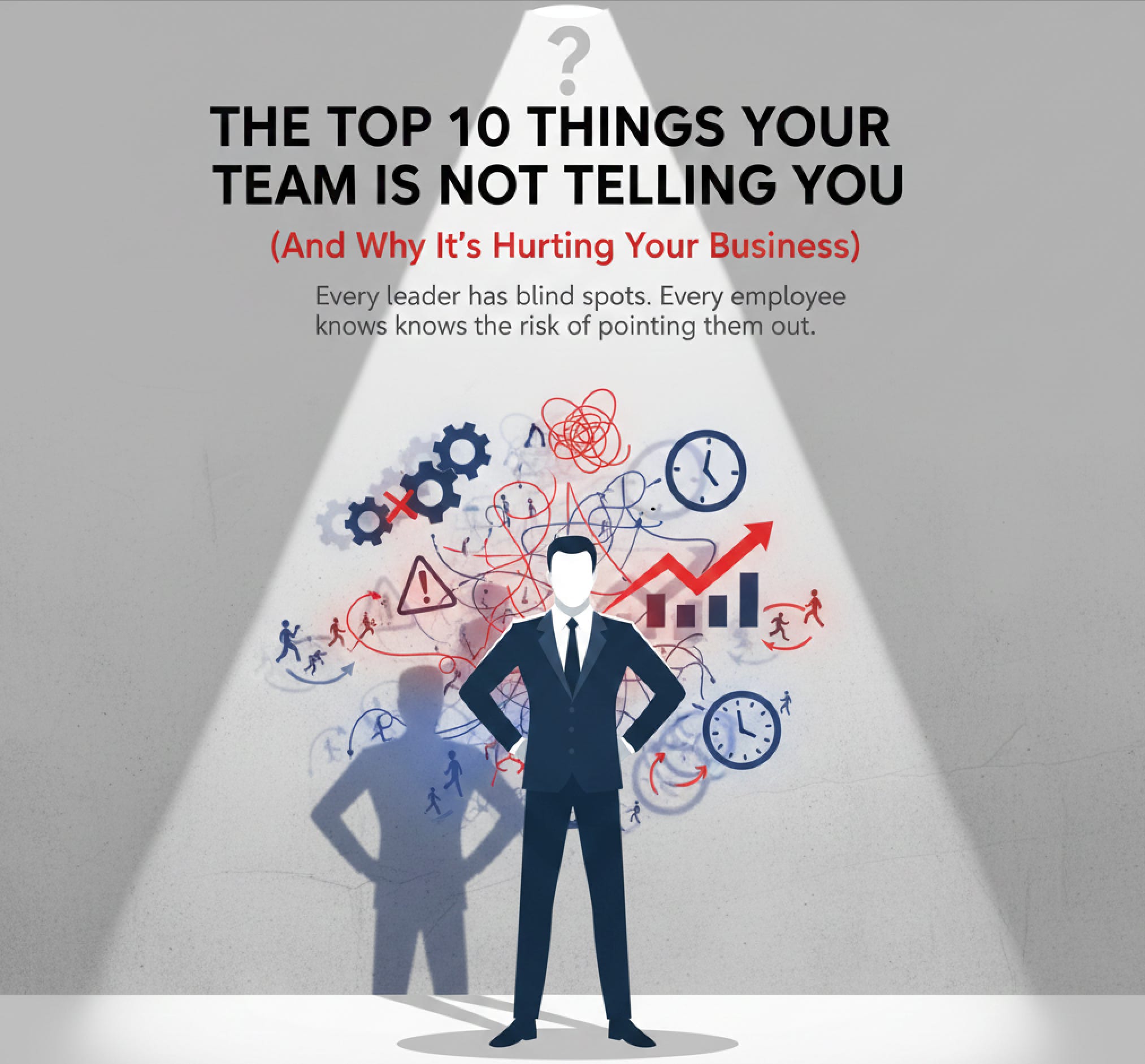
Every leader has blind spots. Every employee knows the risk of pointing them out.
Here are the top 10 things your team is not telling you.
1. Misalignment
Your pet project isn’t what the market wants.
Most employees would never say it. Challenging a leader’s beloved initiative feels like challenging the leader themselves. The fear? Being labeled “negative” or not a “team player”.
2. Siloes
Internal turf wars are slowing everything down.
Teams maintain a veneer of harmony, while friction festers underneath. Speaking up feels unprofessional and political, so no one does.
3. Friction
Your newest hire is the biggest bottleneck.
This is the truth every team dreads raising. It feels like criticizing your judgement, authority, and your ability to pick talent.
4. Competency
We don’t actually have the skills to do what you’re asking.
Most people would rather struggle privately than risk looking incompetent. Employees fear being exposed, judged, or replaced.
5. Ambiguity
We don’t know who actually owns this decision.
In matrixed organizations, admitting confusion about ownership can be misread as incompetence. So instead, progress stalls from uncertainty no one wants to expose.
6. Blindspot
A startup is gaining ground, and we’re not tracking them.
Acknowledging a threat forces the team to confront something uncomfortable: the market is shifting, and the company is not shifting with it.
7. Vendor
The multi-million dollar vendor we hired is failing.
When a leader champions a vendor, employees hesitate to show cracks. No one wants to embarrass the person who signed the contract.
8. Overload
Your priority list is impossible.
Teams swallow the frustration because pushing back can be misconstrued as resistance. So they try to do it all, and quietly burn out.
9. Inefficiency
Half our week disappears into low-value meetings.
Meetings become rituals. Challenging a ritual feels like challenging the organization itself.
10. Irrelevance
Much of our work doesn’t ladder up to the strategy.
This is the scariest truth of all, because it highlights that their work is misaligned, and they worry their job isn’t secure.
The good news: Silence is reversible
If your instincts tell you that something is off and that your team is holding back, they probably are.
But this can be fixed.
In my experience, reversing silence comes down to three core leadership behaviors:
1. Open the door.
2. Seek the truth.
3. Value the mess.
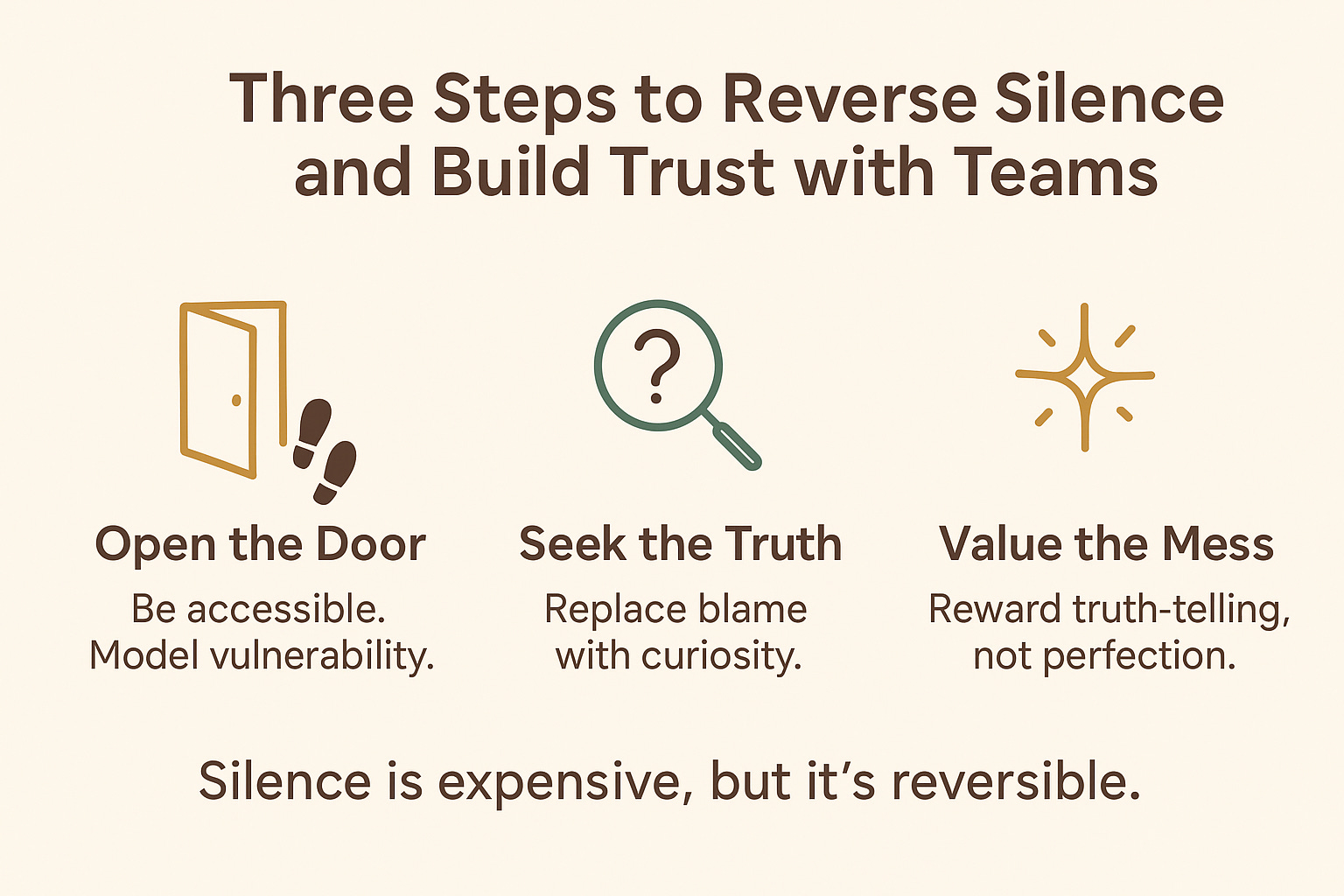
1. Open the Door.
Be accessible. Model vulnerability.
When leaders disappear into meeting rooms or offices, employees interpret it as disinterest.
The fix is simple: be visible.
Walk the floor.
Sit with your team.
Show up where the work is happening.
Reed Hastings, Netflix’s co-founder, famously worked without an office, choosing open spaces because they encouraged organic interaction and constant, unfiltered feedback. His presence sent a clear message: I’m here, and I’m ready to listen.
But visibility alone isn’t enough. You need structure behind it:
Hold consistent skip-level one-on-ones.
Ask disarming questions like:
What do you need me to START or STOP doing?
On a scale from 1 to 10, how well resourced are you?
Create anonymous reporting mechanisms for risks no one wants to raise publicly.
And model the behavior yourself:
Admit mistakes. “I own that call. Here’s what I misjudged.”
State your biases upfront. Invite others to correct them.
Show who you are. Be vulnerable.
Vulnerability is contagious. When leaders show it, something amazing happens. Teams begin to mirror it.
When I meet a new team for the first time, I always start with a “This is Me” slide, a single page where I share parts of my life that can’t be Googled or found on LinkedIn. No accomplishments. No titles. Just the real, human things that shape who I am.
What happens next is remarkable.
People open up. They share back. Walls drop.
And in every organization where I’ve used this approach, the practice has spread far beyond my direct team. Leaders and employees began introducing themselves the same way, creating a culture where authenticity wasn’t just encouraged, it was modeled.
2. Seek the truth.
Be curious.
Most leaders interpret silence as alignment. More often it’s fear.
Instead of evaluating, explore:
“What needs to happen next?”
“How could we have done this better?”
“If you were leading this project, what would you change?
Avoid the most silence-inducing phrase in corporate life:
“Are there any questions?”
Try instead:
“What part of this plan do you trust the least?”
“What’s the one reason this could fail?”
“What’s missing?”
Structure meetings to invite participation.
During meetings when the presenters are sharing customer insights and research, I try to ask “Did anything surprise you about the findings?”.
When a decision is being discussed, ensure that everyone speaks once before it’s made. It pulls quieter thinkers into the conversation and prevents dominant voices from taking over.
3. Value the mess.
Reward truth-telling, not perfection.
Psychological safety isn’t soft. It’s strategic.
As Harvard professor Amy Edmonson, whose work I first encountered at HBS, notes: “Psychological safety is the single most important factor in team learning and innovation.”.
When someone surfaces a hard truth:
Appreciate the courage before evaluating the content.
Treat failure like data.
Run blameless post-mortems that ask why, not who.
Distinguish preventable errors from intelligent failures.
Avoid the cardinal sin of punishing the messenger.
One moment of frustration can erase months of trust.
The Cultural Flip
Leaders who adopt these practices transform their organizations:
From:
Cultures of impression management
(Hide problems to look competent)
To:
Cultures of truth-telling
(Expose problems to improve the system)
The payoff is measurable:
Higher engagement, better decisions, and sharper execution.
Truth-telling isn’t just good for your team — it’s good for your business. Let’s make it happen.
📩 DM me if you are experiencing these issues and we can workshop them together.
💬 Reply here and share your own experience with hidden truths in your organization.