


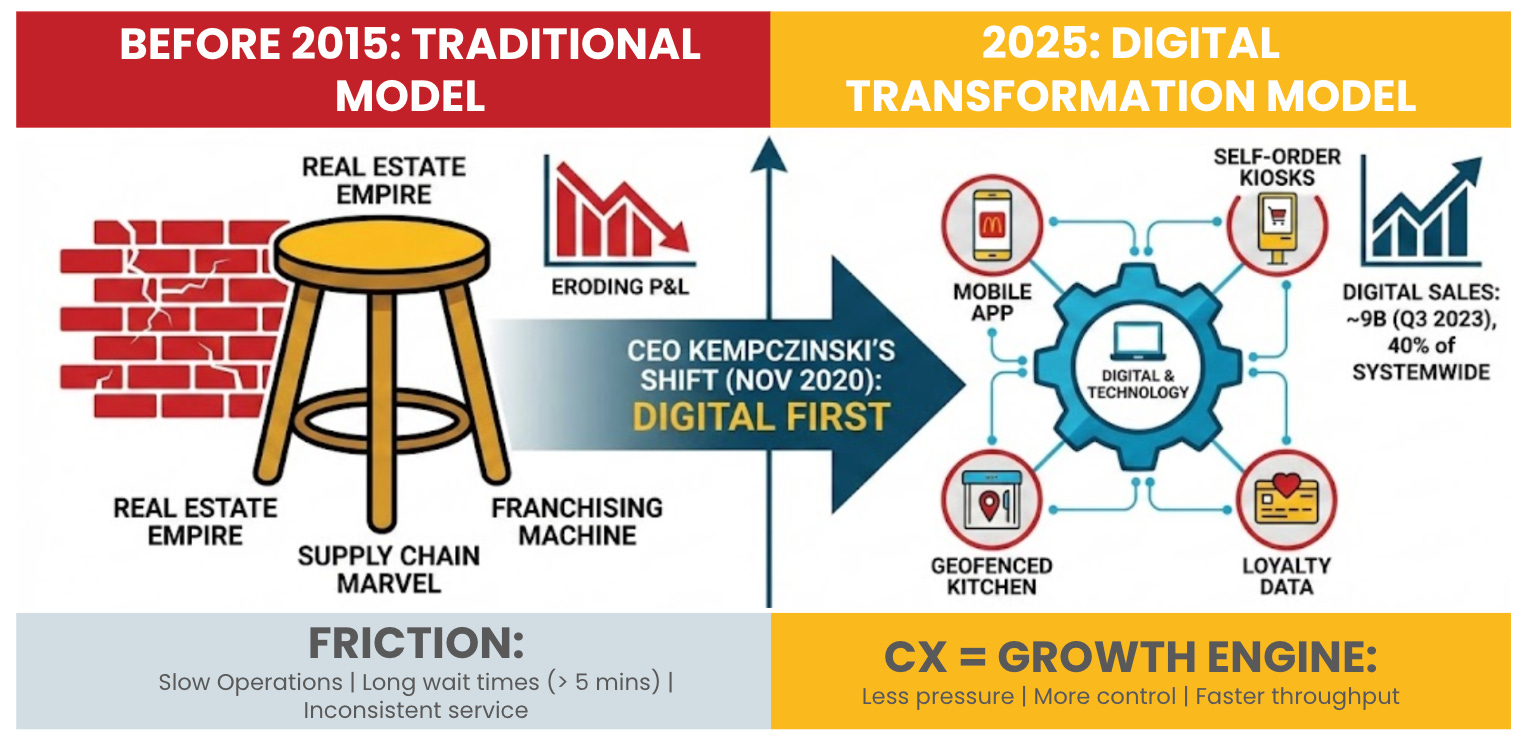
For decades, McDonald’s was defined by its ‘three-legged stool’: a real estate empire, a supply chain marvel, and a franchising machine at unmatched scale. That model worked extraordinarily well, until it didn’t/
By the mid-2010s, the company began to encounter structural friction. The issue wasn’t food quality or brand recognition. It was the cumulative drag of a customer journey that had grown misaligned with modern expectations. That friction slowed throughout, strained operations, and quietly eroded the P&L.
In Nov 2020, CEO Chris Kempczinski signaled a shift: “Today, there is no bigger growth opportunity than the one that we see in digital and technology.”
This was not rhetorical. It signaled a fundamental reorientation toward customer experience as a primary growth lever. McDonald’s chose to
Prioritize digital infrastructure over traditional operational levers and
Shift leadership focus and KPIs across the company.
The result is one of the clearest large scale examples of CX driven transformation in modern retail.
Today, digital sales exceed 40% of systemwide sales in McDonald’s top markets, reaching $7B in Q3 2024 alone.
McDonald’s understood a truth some legacy leaders still resist: customer experience is not a cost center; it is a growth engine.
The Starbucks Connection (A Brief Digression)
In the 2010s, McDonald’s was losing ground to tech-forward competitors like Starbucks and Chipotle. Speaking of Starbucks, I’ll have to share the story in a future newsletter about their first digital app. Hint: We at PayPal actually created it. It’s a true story of early fintech meets coffee, involving lots of A/B testing and coffee runs to Starbucks on the PayPal campus. But I digress. Back to the Golden Arches.
⭐ The Pain Points that McDonald’s Could Not Ignore
By 2015, McDonald’s was under pressure.
Declining relevance with younger customers, who increasingly preferred digital interactions)
Peak hour wait times exceeding 5 minutes (well above the 3-minute industry standard)
Inconsistent Service quality across locations and crew members
These were often framed as technology problems. They were not. They were human problems manifesting operationally.
In my experience leading product organizations, this distinction matters. Companies invest significant capital, talent, and sometimes expensive consulting firms. This can lead to building solutions around internal assumptions and bias rather than customer or product-market fit, sometimes justifying prolonged misalignment under the banner of “failing fast”, even as resources drain away.
McDonald’s made a different choice. It invested in customer research and learned that customers were not asking for technology. They were asking for ease.
Specifically:
Less pressure: No one likes the stress of a line forming behind them while they try to remember a complex family order.
More control: The ability to customize a meal without the friction of a verbal “game of telephone” at the register.
More convenience: A way to get hot food without the traditional “park and wait” bottlenecks.
Customers may not articulate solutions, but they are clear about their pain points. Digital became the answer not because it was fashionable, but because it was the only scalable way to bridge the gap between a 70 year old fast food chain and the modern expectations of a seamless and delightful customer experience.
⭐ The First Bet: Self-Order Kiosks
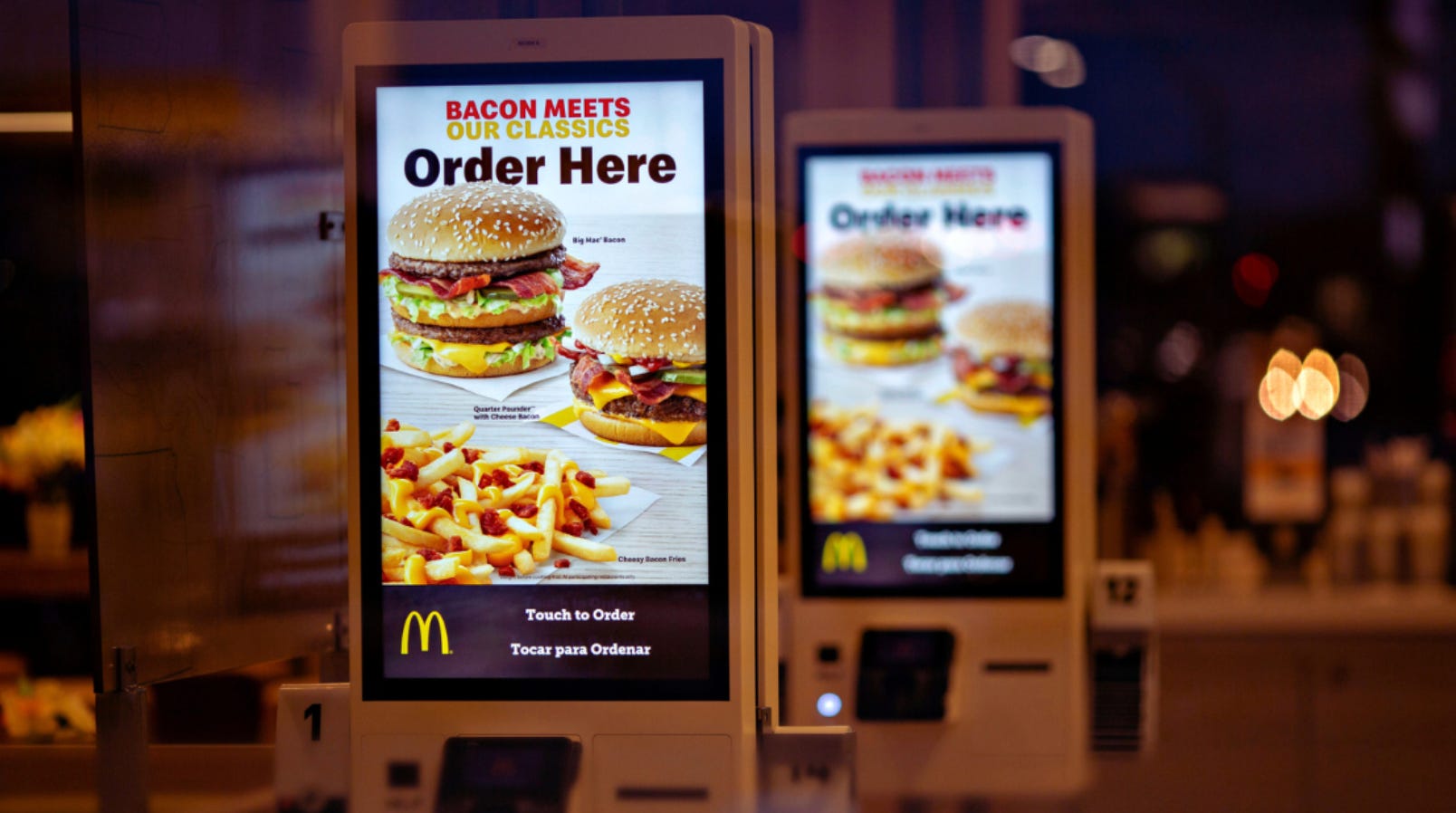
One of the first bets (controversial at the time) that McDonald’s made was rolling out self-order kiosks. Franchisees worried about cost, disruption, and adoption. These concerns were valid.
But leadership pushed forward because kiosks solved a specific friction point: pressure at the counter.
For the first time, customers could browse at their own pace, and customize without embarrassment. For McDonald’s, kiosks created consistent, low-pressure upsell opportunities.
The result?
Kiosks didn’t just improve CX; they increased average order value. When they removed the pressure of the line, customers spent more.
As one of my former CEOs often put it: “improving CX + EX = ↑EBITDA. When customer and employee experience are neglected, technology can be an expensive ornament.
⭐ The Second Bet: The Mobile App
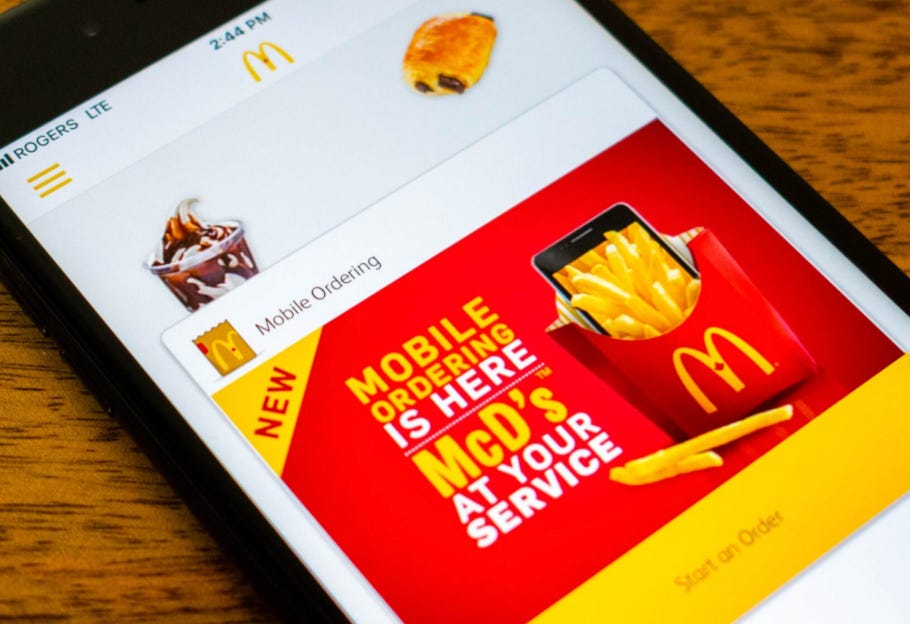
The mobile app began as a simple digital coupon book. Building this required building capabilities in a culture and business model that were never needed before
Leadership made a decisive call: “We’re going to build digital capabilities even if we don’t know how yet.”
Today, the app anchors the ecosystem. It drives loyalty, repeat visits, and data-driven personalization at scale. More importantly, it established a direct, data rich relationship with the customer, something McDonald’s historically lacked.
⭐ The Third Bet I want to highlight: Fixing the Kitchen “Last Mile”
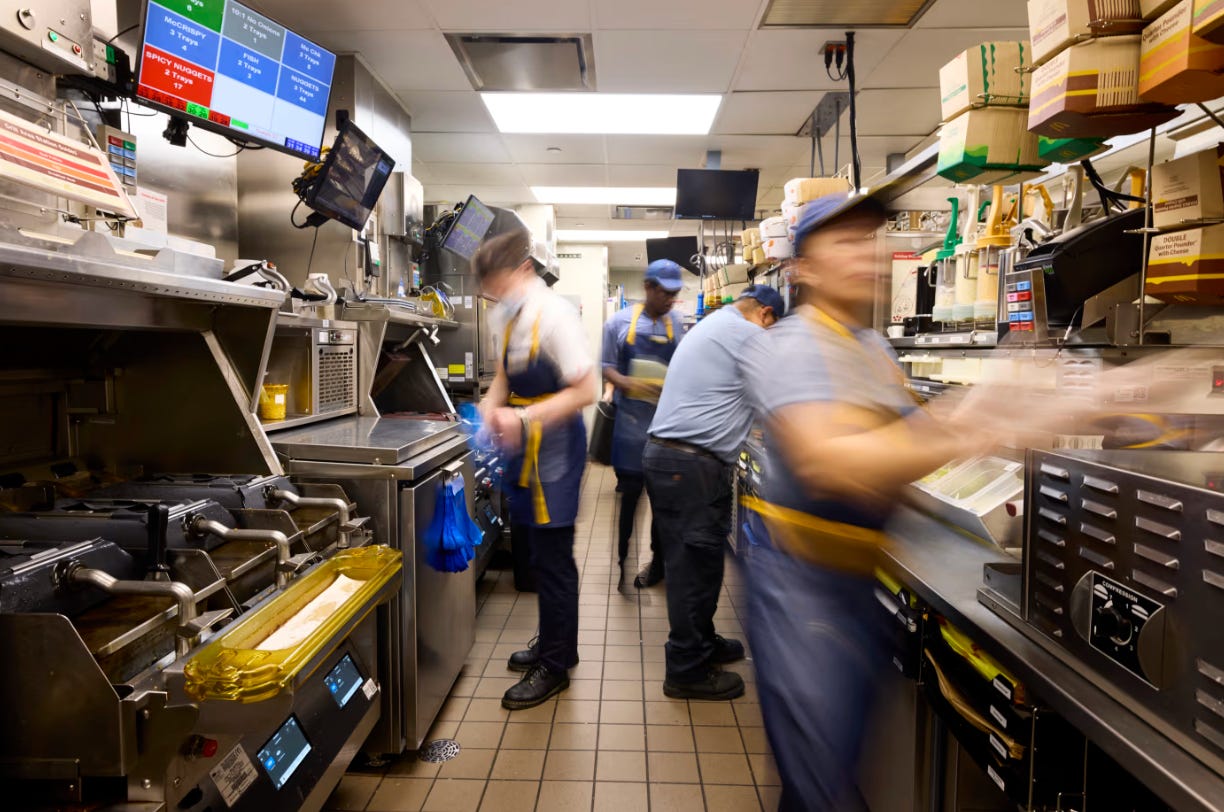
Front-end digital/AI experiences (mobile app) fail quickly if back-of-house operations remain analog.
McDonald’s recognized that true friction removed from the CX falls apart the moment a car pulls into the parking lot.
This is where some legacy brands struggle. They build the digital front end but leave the back of the house untouched.
Previously, mobile orders were treated like drive-through orders, the kitchen began cooking only once the customer arrived. With geofencing, kitchens are alerted when the customer is approximately three minutes away.
This enabled:
Real-time Sync: The meal is prepped exactly as the car pulls into the lot.
Nearly 50% reductions during peak periods. Allowing them to handle higher volumes without increasing kitchen stress.
Elimination of the industry-wide “park and wait” bottleneck.
My son worked at McDonald’s as a teenager. In training, they were taught that if a customer complains food isn’t warm, make a fresh meal. That’s the brand promise. The key to McDonald’s digital transformation was to transform both how a customer places an order AND the kitchen’s ability to fulfill it quickly and accurately.
In March 2025, McDonald’s announced that all 43,000 restaurants would receive a technology upgrade, including internet connected kitchen equipment, AI-enabled drive-throughs and AI-powered tools for managers and crew. The will drive better experiences for its crew, reinforcing the link between CX, EX, and financial performance.
⭐ The Flywheel Effect: Why their Growth is Exponential
The launch of MyMcDonald’s Rewards in 2021 was the final piece of the puzzle. Anonymous transactions became known customers. Data informed operations. Operations improved experience. Experience drove loyalty.
This created their Digital/AI Growth Flywheel:
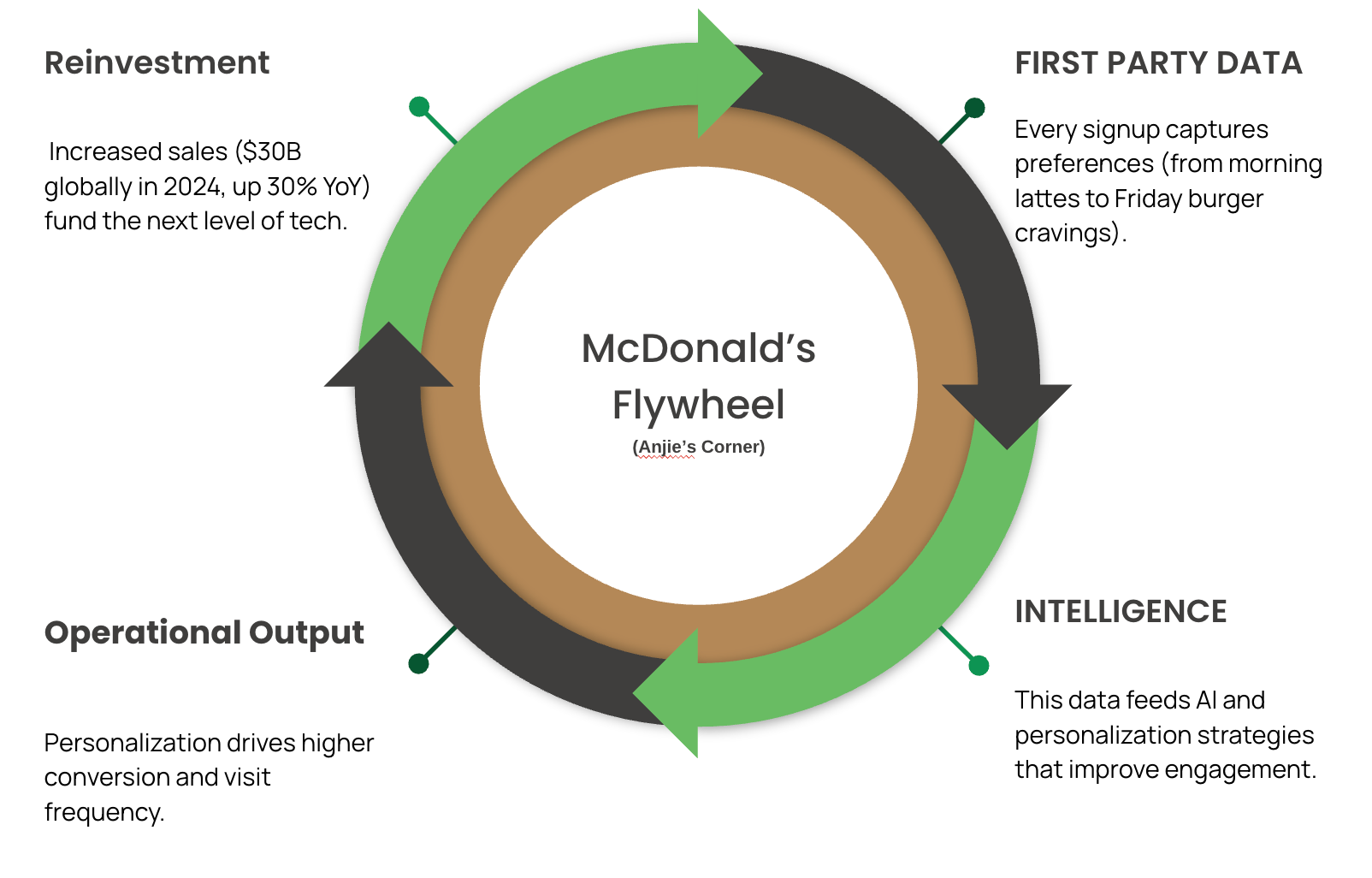
At this point, McDonald’s realized something fundamental: Digital was no longer supporting the business. Digital was the business.
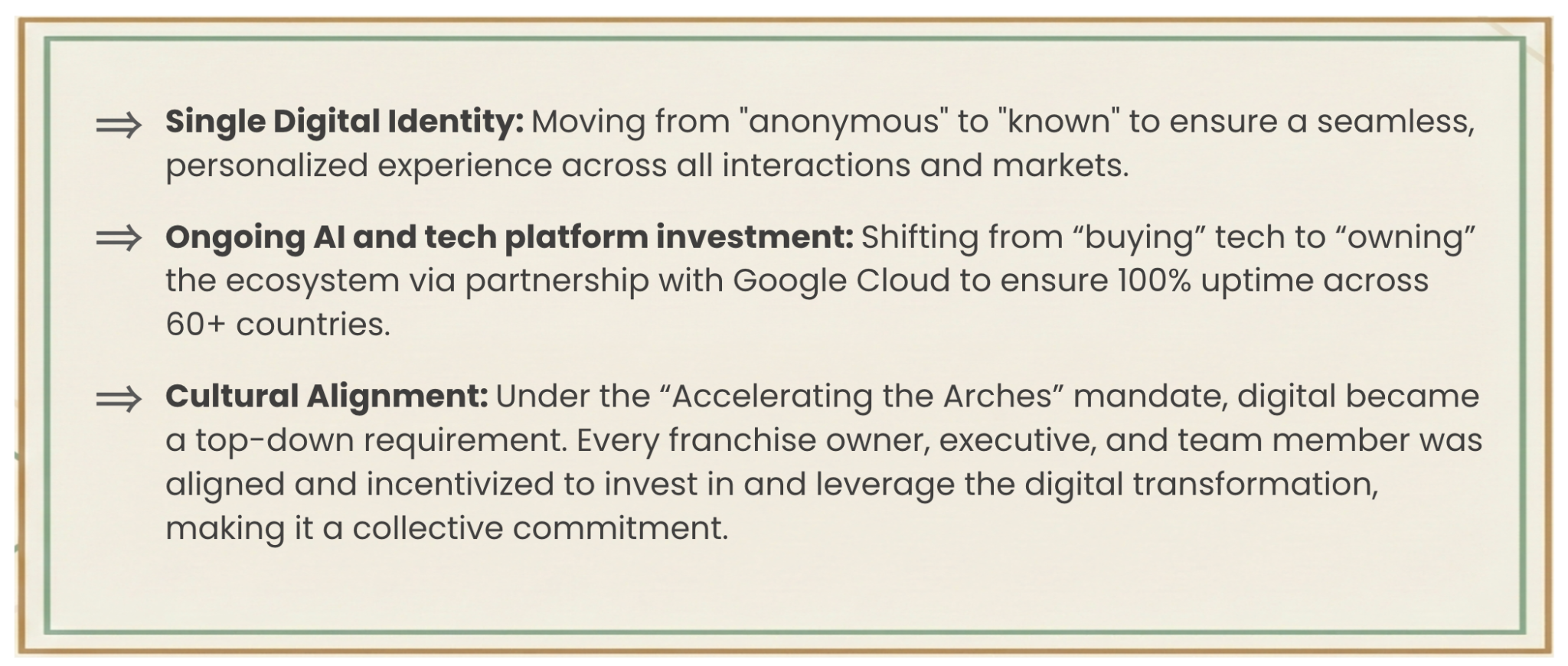
They aligned the company around three operational shifts:
⭐ The Takeaway for Leaders
McDonald’s didn’t become a digital powerhouse by chasing technology. It became one by relentlessly improving customer experience.
Digital was the tool.
CX was the strategy.
Growth was the outcome.
If an 85 year old global fast food chain can reinvent itself through customer experience, any company can.
But only if leadership is willing to treat CX not as an initiative but as the most scalable, defensible, and profitable growth strategy available.
If you're navigating these silos or trying to move past the "pilot trap," I’d love to trade notes. Reach out to discuss your own transformation journey.